Our Commitment to Patients and Caregivers

At Taysha Gene Therapies, patients, caregivers and families affected by central nervous system disorders are at the heart of everything we do.

We are dedicated to understanding their unique challenges and committed to putting their needs first as we work to deliver potentially life-changing therapies.

Gene Therapy for Rett Syndrome

Rett syndrome is caused by a mutation in the MECP2 gene. This gene gives cells instructions to make MeCP2 protein. Mutations to the MECP2 gene can cause some cells in the body to make too little working MeCP2 protein or none at all. Without enough of this protein, the brain and nervous system can’t grow and function the way they should.

TSHA-102: Taysha’s Investigational Gene Therapy for Rett Syndrome

Taysha is developing an investigational gene therapy for Rett syndrome – TSHA-102 – a one-time treatment designed to address the root cause of the condition.

TSHA-102 uses a modified virus called adeno-associated virus 9 (AAV9) to deliver the MECP2 gene to target cells – an approach that has been used safely in thousands of patients. TSHA-102 was carefully designed with a version of the MECP2 gene that is well suited for delivery using AAV9. TSHA-102 includes the essential parts of the MECP2 gene needed to make a functional protein. This streamlined approach helps the therapy fit within the delivery system and allows room for added features to support how the therapy works in the body and how it is administered:

  • Double-stranded DNA, which helps cells make the MeCP2 protein much more efficiently–about 10 to 100 times better than single-stranded approaches
  • A regulatory element (miRARE), which helps to ensure the therapy works only in cells that lack enough MeCP2 protein
  • Intrathecal (IT) delivery, meaning the therapy is given by injection into the lower spine (lumbar puncture), a common and minimally invasive way to deliver treatment to the central nervous system. This delivery approach enables broad, consistent distribution of TSHA-102 throughout the brain and spinal cord

Learn more about the role of the MECP2 gene and how TSHA-102 is designed to work.

Additional education about gene therapy is available from the American Society for Cell and Gene Therapy.

Community Letters

We’re committed to keeping the Rett community updated on the progress of TSHA-102 every step of the way.

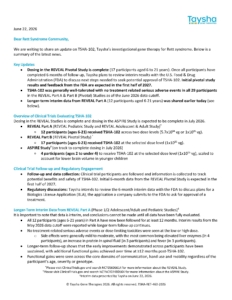
Read our most recent letters to the Rett community about TSHA-102 developments.

Latest Letter: June 22, 2026

Previous Community Letters:

About Our Clinical Trials

TSHA-102 is currently being studied in several ongoing clinical trials. The REVEAL Studies (Part A and Part B) are evaluating the safety and potential benefits of TSHA-102 in girls and young women under 22 years old. In addition, the ASPIRE Study is exploring safety and potential benefits of TSHA-102 in young girls (aged 2 to 3).

   Phase 1/2 Study

Goals of the Study

  • Studying safety, tolerability and potential benefits of TSHA-102 at two different dose levels in a total of 12 girls and young women (aged 6 to 21) with Rett syndrome

Current Status

  • The 1×10¹⁵ total vector genomes (vg) dose was selected for further study
  • All participants who received TSHA-102 have now been followed for at least 12 months from dosing
  • Longer-term results from the May 2026 data cutoff have been reported while ongoing follow-up continues

Longer-term Data*

  • TSHA-102 was generally safe and well-tolerated across doses, with no serious side effects or dose-related safety concerns
    • The most common side effects were elevated liver enzymes (in 4 participants), an increase in protein in spinal fluid (in 3 participants)  and fever (in 3 participants). Side effects were generally mild to moderate in severity
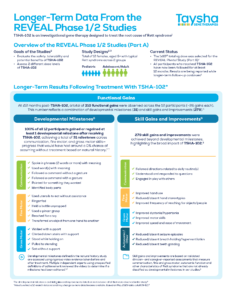
  • At ≥12 months post-TSHA-102, a total of 310 functional gains were observed across the 12 participants (about 26 each)
    • 100% of all 12 participants gained or regained at least 1 developmental milestone after receiving TSHA-102, achieving a total of 31 milestones across communication, fine motor and gross motor skills— progress that would have had around a 0% chance of occurring without treatment based on natural history
    • 279 skill gains and improvements were achieved beyond developmental milestones, highlighting the broad impact of TSHA-102
  • Longer-term follow-up shows that the early improvements demonstrated across participants have been sustained, with additional functional gains achieved over time at ≥12 months post-TSHA-102
  • Functional gains were seen across the core domains of communication, hand use, mobility and autonomic function regardless of the participant’s age, severity or genotype

*Results reflect a 12-month data cut and may change as more data become available; Based on May 2026 data cutoff (N=12).

Read more on ClinicalTrials​.gov (Identifier: NCT05606614)

Dive deeper into the clinical trials of TSHA-102 and the longer-term results from the REVEAL Phase 1/2 Study. 

   Pivotal Study (Part B)

Goals of the Study:

  • Studying potential benefits and safety of the 1×10¹⁵ vg dose of TSHA-102 in 15 girls and young women (aged 6 to 21)
  • The primary goal is to evaluate whether participants gain or regain important developmental milestones related to communication, fine motor function and gross motor function

Current Status:

  • Dosing is complete. 17 participants (ages 6-21) received TSHA-102
  • Participants will be followed to track potential benefits and safety of TSHA-102 for several years after treatment
  • Taysha has aligned with the FDA on an interim analysis at the 6-month time point of the REVEAL Pivotal Study. The main study results are measured at 12 months, but this earlier analysis may help create a faster path to approval

Read more on ClinicalTrials.gov (Identifier: NCT05606614)

   ASPIRE Study

Goals of the Study:

  • Studying the safety and potential benefits of TSHA-102 in girls (aged 2 to 3) with Rett syndrome

Current Status:

  • Enrolling 4 participants (ages 2 to under 4) to receive TSHA-102 at the selected dose level (1×10¹⁵ vg), adjusted to account for smaller brain volume in younger children
  • Participants will be followed to track safety and potential benefits of TSHA-102 for several years after treatment

Read more on ClinicalTrials.gov (Identifier: NCT07480564)

What’s next for TSHA-102

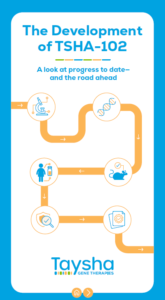
Follow the progress to date with TSHA-102 and what the future may hold for this investigational gene therapy for Rett syndrome.

Resources and Support

Information and support are available from patient advocacy organizations such as:

United States

Canada

United Kingdom

Stay Connected with Taysha

Sign up for the latest updates, information and resources about TSHA-102.

Fields marked with an asterisk (*) are required.

By signing up, you agree to receive communications from Taysha Gene Therapies about Rett syndrome, research and treatment developments, educational resources, programs, services, and related information that may be relevant to your interests. 

The information you provide may be used to personalize communications, improve resources and engagement activities including advertising, better understand your needs and interests, and support research, educational, and business planning purposes. 

You may receive communications through email, social media, digital advertising on our site or third-party sites, or other channels, where permitted by law. We may work with trusted partners and service providers to support these activities in accordance with our Privacy Notice. You may opt out at any time. 

Patient Affairs

Taysha’s Patient Affairs team is dedicated to:

  • Listening to and learning from the patient and caregiver community to better understand their lived experiences, and integrating these learnings into Taysha’s overall business approach
  • Providing transparent information about our research to the community whenever possible and in alignment with industry guidelines and regulations
  • Offering educational resources to help families better understand the many facets of clinical research and investigational genetic medicines to support informed conversations and decision-making
  • Partnering with patient advocacy organizations on key initiatives that help to raise awareness and progress research for rare diseases

Emily McGinnis
Chief Patient and External Affairs Officer

Chelsea Karbocus
Executive Director, Patient Advocacy

Kristin Phillips
Senior Director, Patient Experience

Karen Wagenbrenner 
Director, Study Participant Support Liaison 

For support, reach out to our Patient Affairs team at .