Patients & Caregivers

We strive to be a strong ally to advocacy organizations and the communities they support.

Our Commitment to Patients and Caregivers

At Taysha Gene Therapies, patients, caregivers, and families affected by rare central nervous system disorders are at the heart of everything we do.

We are dedicated to understanding their unique challenges and committed to putting their needs first as we work to deliver potentially life-changing therapies.

Guiding Principles

Our decisions and activities are guided by the following principles:

Collaboration
Transparency
Curiosity
Empathy
Respect

Gene Therapy for Rett Syndrome

Rett syndrome is a monogenic disease. This means it is caused by a change (mutation) in just one gene—the MECP2 gene. This gene gives the body instructions to make a protein called MeCP2, which is important for the brain and nervous system.

When the MECP2 gene doesn’t work properly, the body makes too little—or none—of the MeCP2 protein. Without enough of this protein, the brain and nervous system can’t grow and function the way they should.

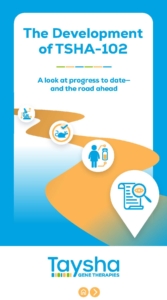
Taysha is developing TSHA-102, an investigational gene therapy for Rett syndrome. This one-time treatment is designed to address the root cause of Rett syndrome: the MECP2 gene. TSHA-102 is administered through an intrathecal injection in the lumbar region of the spine (spinal tap), a well-known minimally invasive medical procedure that delivers the therapy directly into cerebrospinal fluid (CSF).¹ CSF naturally and consistently flows through the brain and spinal cord, ensuring widespread biodistribution across the brain and spinal cord regions impacted in Rett syndrome.2,3

Additional education about gene therapy is available from the American Society for Cell and Gene Therapy.

Our Clinical Trials for Rett Syndrome

TSHA-102 is an investigational gene therapy being evaluated for the treatment of Rett syndrome in our REVEAL and ASPIRE Studies. The TSHA-102 clinical program is designed to support the potential future approval for a broad population of patients aged 2 years and older with Rett syndrome through an efficient and rigorously designed pathway.

REVEAL Phase 1/2 Study   

The REVEAL Phase 1/2 Study, also known as Part A, evaluates the safety, tolerability and preliminary efficacy of TSHA-102 at two different dose levels (5.7×10¹⁴ vector genomes (vg) and 1×10¹⁵ vg) to determine the dose for the pivotal trial. A total of 12 participants, aged 6 to 21 years, were treated with TSHA-102 in Part A of the studies. Enrollment in Part A is complete.

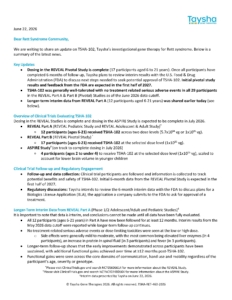
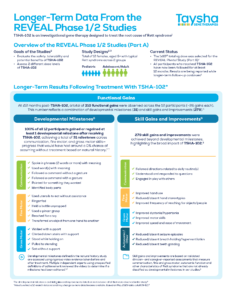
In May 2025, we announced positive results from the REVEAL Phase 1/2 Study, where all participants gained or regained one or more developmental milestones across communication, fine motor/hand function and gross motor function following administration of TSHA-102 as of the May 19, 2025, data cutoff. Participants also showed improvements across multiple standardized Rett syndrome assessments. There were no treatment-related serious adverse events or dose-limiting toxicities across the 12 participants treated with TSHA-102. For additional information on the interim results, read our June 2025 Community Letter.

REVEAL Pivotal Study 

The REVEAL Pivotal Study, also known as Part B, focuses on evaluating the efficacy and safety of the 1×10¹⁵ vg dose of TSHA-102 to support the program’s potential regulatory approval. This single-arm (no placebo group) study, with each participant serving as their own control, is enrolling 15 females aged 6 to <22 years with Rett syndrome. The study is evaluating whether participants gain or regain important developmental milestones across the domains of communication, fine motor function and gross motor function. Enrollment in the REVEAL Pivotal Study is underway.

(ClinicalTrials​.gov Identifier: NCT05606614)

ASPIRE Study 

The ASPIRE Study will evaluate the safety and preliminary efficacy of TSHA-102 in three females aged 2 to <4 years with Rett syndrome. The study will evaluate the same dose as the REVEAL Pivotal Study (1×10¹⁵ vg), adjusted to account for the smaller brain volume in children aged 2 to <4 years. Data collected will be included in regulatory submissions to support the potential approval of TSHA-102 for a broad population of patients aged 2 years and older with Rett syndrome.

Community Support and Resources

Information and support are available for families affected by Rett syndrome from patient advocacy organizations such as:

United States

Canada

United Kingdom

Patient Affairs at Taysha

Taysha’s Patient Affairs team is dedicated to:

  • Listening to and learning from the patient and caregiver community to better understand their lived experiences, and integrating these learnings into Taysha’s overall business approach
  • Providing transparent information about our research to the community whenever possible and in alignment with industry guidelines and regulations
  • Offering educational resources to help families better understand the many facets of clinical research and investigational genetic medicines to support informed conversations and decision-making
  • Partnering with patient advocacy organizations on key initiatives that help to raise awareness and progress research for rare diseases

Emily McGinnis
Chief Patient and External Affairs Officer

Chelsea Karbocus
Executive Director, Patient Advocacy

Kristin Phillips
Senior Director, Patient Experience

Karen Wagenbrenner 
Director, Study Participant Support Liaison 

To connect with a member of our Patient Affairs team, please contact .

1. Gray SJ, et al. Gene Therapy. 2013;20(4):450-459.

2. Perera A, et al. Acta Neurochir (Wien). 2024;166(1):136.

3. Özütemiz C, et al. Diagn Interv Radiol. 2020;26(6):596-602.